
Reviewed · TOURS IN BUENOS AIRES
Buenos Aires for curious people
Buenos Aires for Curious People is not a quick parade of postcard stops. It is a walking lesson in how Buenos Aires was founded, fought over, shaped by immigration, and marked by Argentina’s difficult recent past. San Telmo and Parque Lezama provide the setting, while guides such as Nicolás, Ignacio, Sophia, and Santiago add the context that turns buildings into stories.
I like the small maximum of eight people, which makes it easier to ask questions and hear the guide on busy streets. I also like the mix of famous places, such as Plaza de Mayo and Casa Rosada, with less familiar stops including the Swedish church and the Memory Walk. The main consideration is pace: this is a real walking tour, and one participant found it less suitable for people who need frequent stops.
Key points at a glance
- A history-first walk: Expect politics, architecture, immigration, culture, and Argentina’s recent past, not just photo stops.
- San Telmo with more substance: Parque Lezama, Plaza Dorrego, the parish church, and Mercado San Telmo form the heart of the route.
- Small groups matter: The maximum is eight people, giving you room to ask detailed questions.
- A serious look at memory: The Memory Walk marks a former clandestine detention, torture, and extermination center from 1976 to 1979.
- A useful city overview: The tour ends at Casa Rosada after visiting Puente de la Mujer and other central landmarks.
- Good value at $33: For two to three hours of guided walking and historical explanation, the price is reasonable, especially if you want context on your first days in Buenos Aires.
Why this walk feels different from a standard city tour
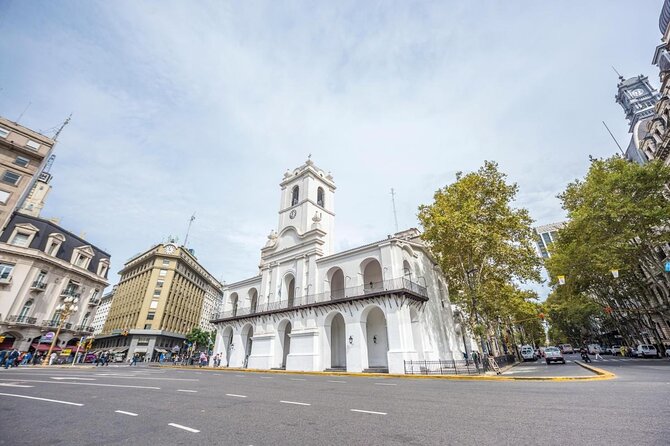
Many city walks give you a name, a date, and a photo opportunity. This one aims for something more useful: an explanation of how the pieces fit together. You will hear about the early settlement of Buenos Aires, the people who shaped its neighborhoods, political conflict, social change, architecture, and the country’s difficult twentieth century.
The route also makes room for questions. Nicolás is described as a local whose family has lived in Buenos Aires for at least three generations, while Ignacio works as a history professor. Other guides, including Sophia and Santiago, bring their own styles to the walk. The common thread is a strong focus on explanation rather than a rehearsed string of facts.
That approach suits me because Buenos Aires can be confusing at first. The grand avenues, old churches, markets, political symbols, and modern towers do not tell one simple story. A good guide helps you read the city instead of simply looking at it.
The tour is capped at eight people. That is a real advantage. You can ask about Argentina’s politics, food, language, architecture, or current affairs without having to shout across a large group. English communication is a particular strength, and one guide even arranged additional language help for a participant whose partner spoke little Spanish.
Other trips people book in Buenos Aires:
- Buenos Aires Hop-On Hop-Off Bus, Free Walking Tours & Discounts
★ 4.5 · 2,218 reviews - Buenos Aires: Piazzolla Tango Show with Optional Dinner
★ 4.4 · 2,122 reviews - Buenos Aires: City Highlights Guided Tour with Transfer
★ 4.7 · 1,946 reviews
Starting at Bar Britanico and Parque Lezama
The meeting point is Bar Britanico at Brasil 399. The bar sits in the old part of Buenos Aires and gives the tour an appropriately local beginning. You are not starting in a coach parking area or a generic shopping district. You begin with the atmosphere of an older neighborhood.
The route includes Parque Lezama, identified as the place where the first fort was established in 1536. The park gives the opening history lesson a physical setting. This is one of the best ways to understand Buenos Aires: start with the ground beneath your feet, then follow the changes brought by colonization, immigration, politics, and urban growth.
Allow about 30 minutes for the park portion. It is not simply a shortcut between two buildings. The guide can use it to explain the city’s beginnings and the way early Buenos Aires developed. Old photographs and maps may be used during the explanation, a helpful touch if you want to see how the city changed over time.
Bar Britanico and Parque Lezama also set the tone for the walk. You begin in an older, more residential-feeling section before moving into the better-known San Telmo sights. Wear comfortable shoes. The route is not strenuous in an athletic sense, but you will be on your feet for much of the afternoon or morning.
San Telmo through churches, markets, and immigrant stories
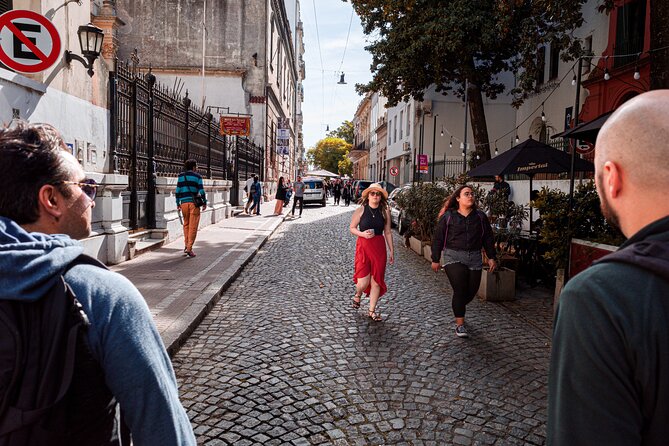
San Telmo is often reduced to tango, antiques, and the Sunday market. This walk gives you a broader view. The route includes the Swedish church, listed as dating from 1944, and Club Sueco Restaurante. It is a small stop, around ten minutes, but it helps show the range of communities that became part of Buenos Aires.
The parish of San Pedro González Telmo adds a different layer. This colonial Catholic church is scheduled for about 15 minutes. You can expect the guide to connect the church with the neighborhood around it, rather than treating it as an isolated religious building.
That context is important. San Telmo is not just an attractive old quarter. It reflects changing populations, older institutions, and the city’s long relationship with trade and migration. The tour’s strength is its habit of moving from a building to the people and events connected with it.
At Plaza Dorrego, the old town’s main square, you will have another 15-minute stop. This is one of San Telmo’s best-known public spaces, but the guide’s explanation can give it more meaning than a quick photograph. Ask questions here if you want help understanding the neighborhood’s role in Buenos Aires life.
Mercado San Telmo receives the longest stop in the district, about 30 minutes. The market was built by Italian immigrants, making it useful for explaining how migration affected the city’s food, work, and social life. This is also the point where the tour can feel most connected to daily Buenos Aires rather than only to official history.
I would plan a small amount of flexibility around the market. The listed stop is 30 minutes, but markets invite lingering. You may want to look at the stalls, follow the guide’s food-related comments, or ask for suggestions for later meals. The tour is not presented as a food tasting, so do not book it expecting a meal or a series of included samples.
The Memory Walk and Argentina’s difficult recent past
The Memory Walk is the most serious stop. It marks a former clandestine center for detention, torture, and extermination that operated from 1976 to 1979. That period belongs to Argentina’s military dictatorship, and this part of the route deals with state violence and political repression.
The scheduled time is about 20 minutes. That is long enough for an explanation, but the subject is not light. If you prefer a tour that stays cheerful and decorative, this may not be the right choice. If you want to understand Argentina beyond its cafés, plazas, and architecture, this stop is essential.
The guides appear to handle the subject with care while placing it within the country’s wider political story. Several parts of the walk address modern Argentina, not just colonial foundations. That is one reason the experience has appeal for people who want to understand present-day social and political questions.
I appreciate that the Memory Walk is included alongside the market and the historic square. It prevents Buenos Aires from becoming a polished museum display. The city’s beauty and its painful memories exist side by side, and a useful tour should not pretend otherwise.
Same base, a different kind of day out:
- Buenos Aires: Hop-On Hop-Off City Bus Tour
★ 4.2 · 1,855 reviews - Buenos Aires Hop-On Hop-Off Bus and Exclusive Benefits
★ 4.4 · 1,714 reviews - Buenos Aires: La Boca Guided Walking Tour in English
★ 4.8 · 1,587 reviews - Buenos Aires: La Recoleta Cemetery Guided Tour in English
★ 4.8 · 1,359 reviews
Puente de la Mujer and the modern city
Puente de la Mujer provides a sharp change of mood and style. The bridge was designed by Spanish architect and structural engineer Santiago Calatrava. Its modern form contrasts with the older streets, churches, and market buildings earlier in the walk.
The stop is planned for about 15 minutes. You will have time to hear about the bridge and take in the setting, but this is not an architectural lecture devoted only to Calatrava. Instead, the bridge helps broaden the tour’s view of Buenos Aires. The city is not frozen in its colonial or nineteenth-century past. It continues to add new symbols and new districts.
The itinerary places the bridge before Casa Rosada, the president’s office. That pairing gives the walk a useful final stretch from contemporary design to the center of national government. It also keeps the experience from feeling like a tour of San Telmo alone.
The exact walking connections between stops matter less than the overall arc. You begin with early Buenos Aires, move through immigration and neighborhood life, confront the dictatorship years, and finish with modern design and national politics. The route has a clear intellectual purpose even if it is not a simple straight line on a map.
Finishing at Casa Rosada and Plaza de Mayo
Casa Rosada is the final stop, with about 25 minutes planned. The pink presidential office is one of the city’s essential landmarks, and the tour uses it as a final point for political and civic context.
Admission to Casa Rosada is not included. The stop is primarily an exterior visit unless your guide and the day’s arrangements provide otherwise. Keep that in mind if entering the building is a priority. The value here comes from understanding the building’s role and its connection to Plaza de Mayo, not from assuming an included interior visit.
Ending here works well for first-time visitors. By this point, you have already encountered the city’s early settlement, old churches, immigrant communities, political violence, and modern architecture. Casa Rosada then becomes more than a pink façade. It represents the national government and the political story that runs through the entire tour.
The endpoint is at Balcarce 78, close to the central sights around Plaza de Mayo. That makes it a practical place to continue exploring after the walk, though no onward plans are included in the experience. You can use the remaining day for nearby landmarks, food, or independent wandering.
What $33 buys you in practical terms
At $33 per person, the tour offers two to three hours of guided walking, a maximum group of eight, and a route covering several parts of Buenos Aires. The cost is fair if you value interpretation and questions more than a long list of attractions.
The stop schedule adds up to roughly 165 minutes before allowing for movement between locations. That fits the advertised duration, but it also tells you to expect a full outing rather than a quick orientation. You are paying for the guide’s preparation and explanation as much as for access to places that are mostly free.
There are no admission fees included for the listed stops, and Casa Rosada admission is specifically not included. That is not a weakness by itself. Most of the value comes from the walking route and the guide’s account of the city.
The group size is the strongest price factor. A large free walk may cover some of the same streets, but it usually gives you less time to ask about Argentina’s political history, local food, architecture, or personal connections to the city. Here, a small group can make the conversation feel more like exploring with an informed local than listening to a distant loudspeaker.
The tour is booked an average of 35 days ahead, so it is wise to reserve before arriving if your schedule is fixed. Confirmation is provided when you book. It requires good weather, and a cancellation caused by poor weather brings an offer of another date or a full refund.
Who should book this Buenos Aires walk
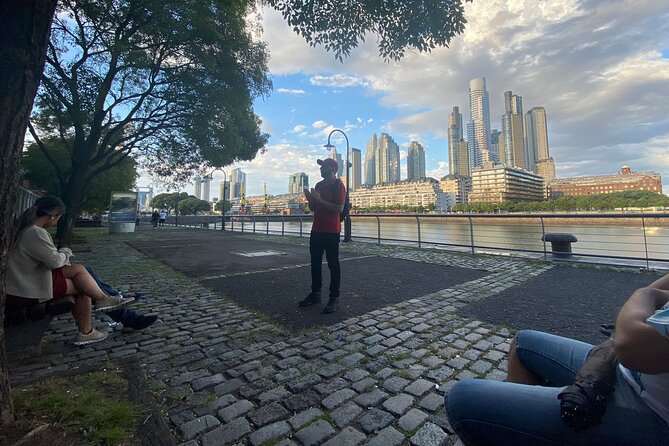
I would choose this for a first or second visit, especially if you want a foundation for the rest of your time in the city. It is also a good match for anyone interested in history, politics, architecture, immigration, and social change.
The experience suits curious adults and families with older children who can manage several hours on foot. Most people can participate, and service animals are allowed. The meeting point is near public transportation, which helps if you are staying outside San Telmo.
I would not choose it for a person seeking only tango, shopping, food tastings, or a relaxed sightseeing ride. It includes markets and local food discussion, but the main product is explanation. The Memory Walk also means the mood becomes serious.
Pace deserves honest attention. One person found the group slowed by an elderly couple who had difficulty with the walking schedule. The tour guide cannot know every participant’s mobility needs in advance, so contact the provider before booking if you need a very gentle pace or frequent seated breaks.
Breaks have been built into some outings, including time for coffee, snacks, and bathrooms. Still, the experience lasts two to three hours and includes multiple stops. Comfortable shoes and a realistic view of your walking ability will make the day better.
My call: book it for context, not just landmarks
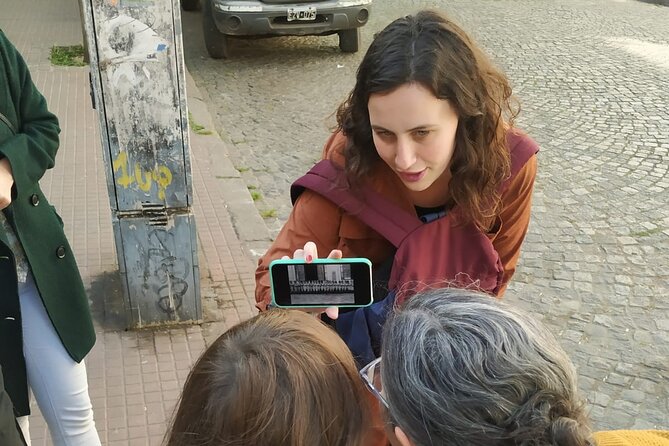
I would book Buenos Aires for Curious People if I wanted to understand the city rather than simply photograph it. The strongest features are the eight-person limit, the serious historical range, the San Telmo focus, and the guides’ willingness to answer questions.
At $33, it is good value for an intimate, history-led walk. You will see Plaza Dorrego, Mercado San Telmo, Puente de la Mujer, and Casa Rosada, but the lasting benefit is the connection between those places.
Book it if you enjoy thoughtful conversation, local stories, and a little political complexity. Skip it if you want a short, light stroll with no difficult subjects. For the right person, this is a smart way to get your bearings in Buenos Aires and start seeing the city with sharper eyes.
FAQ
How long does Buenos Aires for Curious People last?
The experience lasts approximately 2 to 3 hours.
How many people can join the tour?
The maximum group size is 8 travelers.
Where does the tour begin?
The meeting point is Bar Britanico at Brasil 399, Buenos Aires.
Where does the tour end?
The tour ends at Casa Rosada, at Balcarce 78.
Is admission to Casa Rosada included?
No. Admission to Casa Rosada is not included.
Is the tour suitable for most people?
Most travelers can participate, and service animals are allowed. It is a walking tour, so you should be comfortable walking for two to three hours.
What happens if bad weather cancels the tour?
If poor weather causes a cancellation, you will be offered another date or a full refund. You can also cancel for a full refund up to 24 hours before the start time.
Just added in Buenos Aires
- Buenos Aires: Small-Group Wine Tasting★ 4.8 · 18 reviews
- Buenos Aires: Speakeasy & Mixology Bar Tour with Cocktails★ 5.0 · 5 reviews
- Premium Empanadas Cooking Class & Wine Tasting Experience★ 4.9 · 35 reviews
- Buenos Aires: Rojo Tango Show with Optional Dinner★ 3.4 · 3 reviews
- Buenos Aires: Santa Susana Ranch Day Tour, BBQ & Shows★ 4.6 · 32 reviews
- Buenos Aires:Small Group Tour AM & Sunset Open Bar Cruise PM★ 4.5 · 15 reviews
- Buenos Aires: Private Photo Tour for Ammateur Photographers★ 4.9 · 5 reviews
- Buenos Aires: Private Recoleta Cemetery Walking Guided Tour★ 4.6 · 13 reviews
Tours in Buenos Aires, compared.


Browse the lists this tour appears in