
Reviewed · WALKING TOURS
Best of Buenos Aires Private Walking Tour
Buenos Aires reveals its personality through its buildings, and this walk connects the city’s grandest pieces. You’ll move from Florida Street and British-influenced Plaza San Martín to the French-style palaces of Barrio Norte and Recoleta, finishing at the city’s famous cemetery. The stories behind the buildings are the real attraction, especially the links between money, politics, immigration, the church, and Argentina’s complicated relationship with Britain.
I like two things here: the private format, which lets your group ask questions, and the unusual details, from Corina Kavanagh’s decision to sell two ranches to fund her skyscraper to the former British cattle auction house that became Patio Bullrich. The walk also gives you a useful first look at central Buenos Aires without herding you onto a bus.
The main drawback is the amount of ground covered. This is about 2.5 to 3 hours of steady walking, and the route can feel brisk. One earlier description also noted that the cemetery portion was not always included, so ask at the start how much of the full route your guide expects to cover that day.
Key points to know before you book
- Florida Street to Recoleta: The route links downtown shopping streets, Plaza San Martín, Barrio Norte, Avenida Alvear, and Recoleta in one continuous walk.
- At least 25 sights: You’ll see palaces, churches, monuments, embassies, cafés, memorials, and major architectural landmarks.
- Strong local context: The guide explains British influence, immigration, the Falklands War, Argentina’s political past, and the rise and fall of its wealthy families.
- Private English-speaking guide: Only your own group participates, with guides including Martin, Carlos, and Mariano praised for clear English and lively presentation.
- Cemetery admission included: The walk normally includes Recoleta Cemetery, with attention to Evita Perón and many less-famous figures.
- Best for active sightseers: You should be comfortable walking for several hours, often at a steady pace, in changing weather.
From Florida Street to Buenos Aires history
The walk begins outside Florida Garden at Florida 899, near the corner with Paraguay Street. Look for the small BA Walking Tours sign held by, or attached to, the guide. The meeting time is no later than 10 a.m., so arrive early rather than trying to find the group at the last moment.
Florida Street is a smart starting point. This old pedestrian shopping street links Plaza de Mayo, the symbolic center of Buenos Aires, with Plaza San Martín. It is not just a place for shops and city traffic. Your guide uses it to explain how the city grew outward from its founding area and how commerce shaped the center.
The opening section is short, but it sets the tone. You are not simply ticking off monuments. You are learning why Buenos Aires can feel Spanish, French, Italian, and British all at once. The guide also adds small stories about the people who funded the buildings, which makes the architecture easier to remember.
Other guided walks through the barrios:
- Buenos Aires Hop-On Hop-Off Bus, Free Walking Tours & Discounts
★ 4.5 · 2,218 reviews - Buenos Aires: La Boca Guided Walking Tour in English
★ 4.8 · 1,587 reviews - Nazis in Buenos Aires: a historical walking tour
★ 4.9 · 193 reviews
Churches, skyscrapers, and Plaza San Martín
The Basilica del Santísimo Sacramento is an early highlight. Mercedes Anchorena had the church built for her family in 1916, and its history involves the sort of family power struggles and social rivalries that make a city walk entertaining. You may only spend a few minutes here, but the stop gives you a glimpse of how Argentina’s wealthy families used religious buildings to express status and influence.
Next comes the Edificio Kavanagh, facing Plaza San Martín. Its Art Deco form is one of the most recognizable sights on the route. The building was completed in only 14 months and was commissioned in 1934 by Corina Kavanagh, a wealthy woman of Irish descent. She sold two ranches at age 39 to finance the project.
That detail tells you a great deal about Buenos Aires at the time. Private fortunes could produce enormous urban landmarks, and family names mattered almost as much as government institutions. The Kavanagh was once the tallest skyscraper in Latin America and is now recognized as a UNESCO heritage building.
Plaza San Martín adds a more complicated layer. The park has occupied several roles over time, including a fort, a bullfighting ring, and a site near old slave depots. Today, the focus is the monument to General José de San Martín, Argentina’s leading independence hero. A good guide can turn the square into a quick lesson in military history, colonial society, and national identity.
Britain’s mark on the city
The Torre Monumental, formerly called the British Clock Tower, is one of the route’s most useful stops. Its presence makes British influence visible, but the story goes well beyond architecture. Argentina’s economy, farming, railways, trade, and elite culture were all shaped by close ties with Britain.
Across from the tower, the Monument to the Malvinas Combatants shifts the mood. The memorial honors those killed in the 1982 South Atlantic War, known in Argentina as the Malvinas War and in Britain as the Falklands War. Your guide connects the monument with Argentina’s long and uneasy relationship with Britain.
This is a strong example of why a local guide helps. You can photograph a clock tower on your own, but it is harder to understand why that tower and a war memorial face one another. The political history is sensitive, and the guide’s explanation gives the site more meaning without requiring a separate museum visit.
Palaces in Barrio Norte
Palacio Paz is one of the most extravagant buildings on the walk. José C. Paz, owner of one of Buenos Aires’ major newspapers and an aspiring president, commissioned this French-inspired city palace in 1914. Materials were imported from France, and the building contained 120 rooms for a family of four.
You do not need to tour every room to appreciate the point. Palacio Paz shows how Argentina’s upper class looked to Europe for models of taste and power. It also helps explain why Buenos Aires earned its old nickname, Paris of the South.
Palacio San Martín is another former family residence with a political name. It was originally the Anchorena family palace, later renamed for political reasons. Mercedes Anchorena appears again here, along with the nearby Basilica del Santísimo Sacramento. The recurring names are useful. By the end of the walk, you begin to recognize the small circle of families who shaped the city’s architecture and institutions.
Palacio Estrugamou brings you into Barrio Norte, where elegant apartments and Paris-style buildings line the streets. This is one of the route’s quieter pleasures. Instead of rushing between famous monuments, you get time to notice façades, balconies, entrances, and the way the neighborhood changes from commercial downtown to residential grandeur.
The guide also discusses immigration from Spain, Italy, France, and Britain. That matters because Buenos Aires is not simply a European-looking city transplanted to South America. Its buildings reflect European influence, but its social story was formed in Argentina by waves of newcomers and by local economic change.
Other guided walks in Buenos Aires:
- Buenos Aires: Personalized 2 to 8-Hour Private Walking Tour
★ 4.7 · 149 reviews - Buenos Aires: San Telmo and Market Guided Walking Tour
★ 4.8 · 102 reviews - Buenos Aires Walking Tour with Local Guide and Optional Rooftop
★ 4.5 · 87 reviews - Full Day Private Walking Tour of Buenos Aires Neighborhoods
★ 5.0 · 55 reviews
Embassies, memory, and a former cattle auction house
The Plaza de la Embajada de Israel is a sobering stop. A bombing in 1992 destroyed the Israeli Embassy and killed 24 people. The guide explains what happened and places the event within Argentina’s politics, justice system, and international affairs.
You may find the transition from palaces to tragedy abrupt, but that contrast is part of the city. Buenos Aires’ elegant streets carry memories of wealth, violence, migration, political conflict, and public grief. The walk does not limit itself to pretty façades.
The French Embassy occupies what was once the Ortiz-Basualdo Palace. Its stories include a visit by Edward VII of England with his American future wife. Details like this give the building a human scale. You are not only looking at stone and ornament, but also at the social world that once moved through these rooms.
Patio Bullrich offers one of the route’s best surprises. Today it is an upscale shopping center, but the building began as a British-designed auction house in 1867. It hosted sales of prize bulls, thoroughbreds, heirlooms, and other valuable goods for the Bullrich family.
This is a particularly good stop for understanding Argentina’s old economy. Cattle and land created immense fortunes, and British connections helped shape the trade. The polished mall you see today still occupies a building designed for that earlier world.
The church, the rich, and Recoleta
The former residence of the Papal Nunciature brings the church back into the story. The guide explains why Argentina produced a pope and how wealthy women such as Mercedes Anchorena and Adelia Harilaos supported religious institutions. Harilaos eventually donated her palace to the Vatican.
These stories make the route more than an architectural stroll. You see how women of great wealth shaped churches, palaces, and public life, even in a society where formal political power was often held by men.
The walk then reaches Recoleta. The land was given to Franciscan Recollect monks, and the area later developed into one of Buenos Aires’ most polished districts. Paris-style townhouses, former palaces, boutiques, cafés, and broad avenues make this a pleasant place to finish a morning of sightseeing.
Avenida Alvear is the grandest stretch. Your guide points out the mansions and explains Argentina’s period of great wealth from about 1880 to 1930, followed by the country’s decline from that high point. The avenue makes the economic story visible. Lavish buildings show what the country could afford, while the guide explains the forces that later weakened that prosperity.
Recoleta Cemetery and the stories behind the tombs
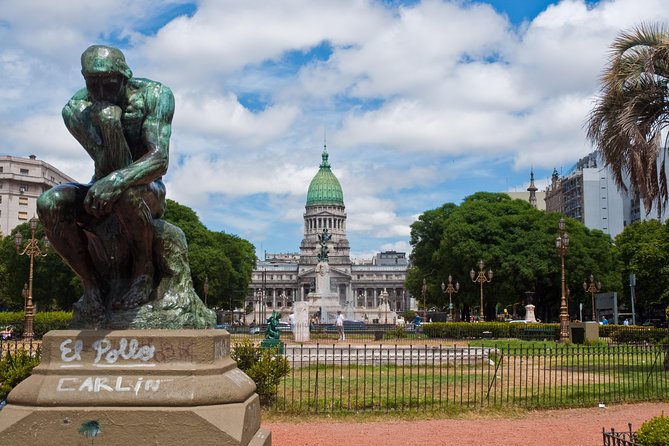
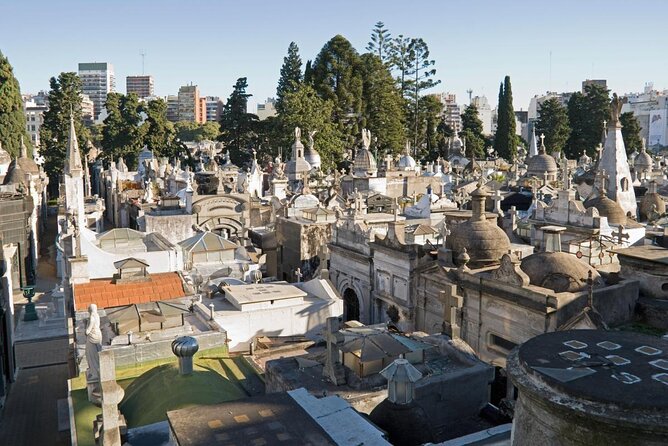
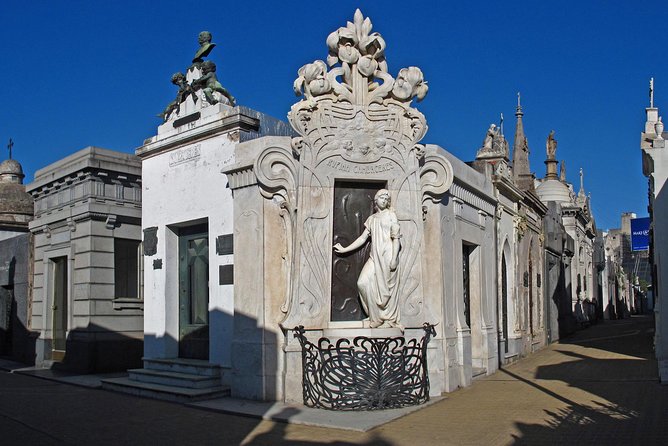
The cemetery is scheduled as the longest stop, at about an hour, and admission is included. This is not meant to be a quick photo stop. You walk among elaborate mausoleums while the guide explains the people, family rivalries, social customs, and strange incidents connected with them.
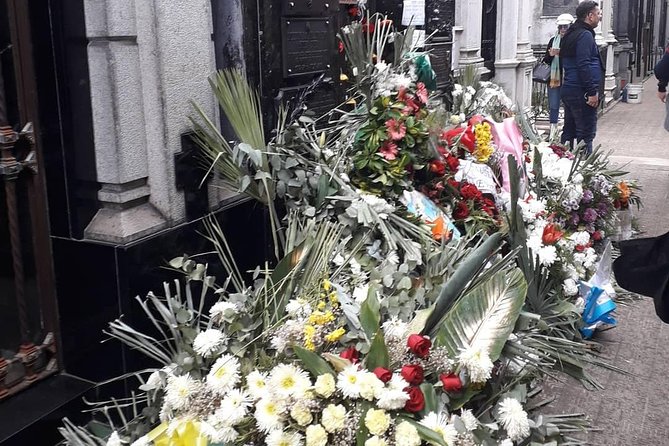
Evita Perón is the best-known name. Her memorial and life story provide a natural entry into Argentine politics, class divisions, and popular devotion. But the visit also includes figures such as Admiral Brown, General Guido, the Leloir family, Liliana Crociatti, and Rufina Cambaceres.
The lesser-known stories are often the most memorable. Rufina Cambaceres’ misfortune and Tiburcia Dominguez’s miserly husband reveal the cemetery’s human side. These are not just tombs for presidents and national heroes. They are monuments to families, fortunes, ambitions, scandals, and grief.
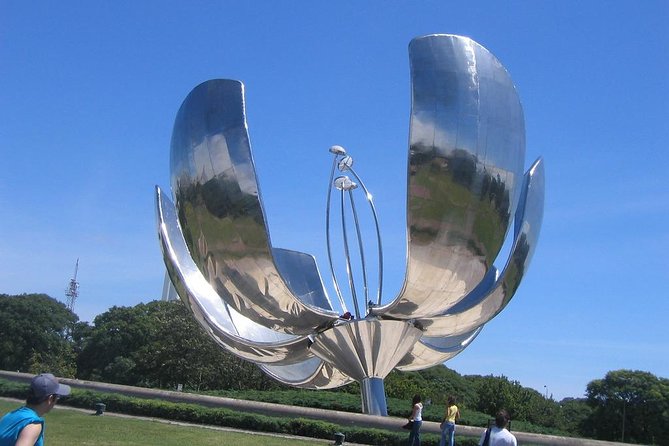
The wider Recoleta area may also enter the discussion, including the old monastery and cultural center, the Palais de Glace, the National Fine Arts Museum, the National Library, the monument to France and Argentina, and the giant flower sculpture when it is available to view closely.
The exact coverage depends on weather, city conditions, timing, and the pace of your group. That point is important. The route promises a lot, and a full treatment of every site is not realistic in a short morning. Ask your guide early if Recoleta Cemetery is definitely included and how much time is planned there.
Finishing at La Biela
The walk ends outside La Biela, the famous café on Avenida Presidente Manuel Quintana. The guide explains the café, the neighborhood, and nearby attractions so you can decide what to do next.
This is a useful ending rather than an awkward one. Recoleta is one of the city’s main restaurant and sightseeing districts, and you can continue to the cemetery, museums, shops, cafés, or nearby streets. The tour does not include hotel transportation, so you are responsible for getting back to your lodging.
What the $109 price buys you
At $109 per person, this is not the cheapest way to see Buenos Aires. The value comes from the private guide and the amount of interpretation packed into a short route. You are paying for context, not transport or meals.
The cemetery admission is included, while food, hotel pickup, and drop-off are not. For a first visit, I think the price can make sense if you want a strong orientation and prefer asking questions as you go. It is less appealing if you mainly want to wander alone, stop often for photos, or spend long periods inside each church and palace.
The private format matters most for history and politics. You can ask about the Falklands War, immigration, Perón, the church, or the city’s economic past without worrying about a large group. Guides such as Martin, Carlos, and Mariano have been singled out for clear English, humor, local insight, and an easy pace, although one account found a guide too focused on promoting other tours and not responsive enough to questions.
Pace, weather, and who should choose it
You should be able to walk for roughly three hours with limited sitting. One description called it solid walking, while another found the pace comfortable and not too demanding. The safest assumption is a steady urban walk with many short stops.
The tour runs rain or shine. Wear comfortable shoes and bring protection from rain or sun. Because the route crosses busy central streets and affluent neighborhoods, city conditions such as strikes, repairs, or demonstrations can affect the exact coverage.
This tour suits you best if:
- You are visiting Buenos Aires for the first time.
- You want architecture explained rather than simply photographed.
- You enjoy political, social, and family stories.
- You prefer a private guide to a large group.
- You have only a few hours for a broad city introduction.
- You want to end in Recoleta with options for lunch or more sightseeing.
It may not suit you if you dislike long walks, need a slow photo-focused schedule, or want extensive interior visits. The route covers a lot from the street, but most buildings are viewed from outside.
Should you book the Buenos Aires walking tour?
Book it if you want a lively introduction to Buenos Aires built around buildings and the people who commissioned them. The route is especially useful early in your stay because it connects downtown, Plaza San Martín, Barrio Norte, and Recoleta, giving you a map of the city and several places to revisit independently.
Before paying, confirm the planned duration and cemetery visit. The published information shifts between 2.5 and 3 hours, and the full list of sights may be adjusted by weather, city events, and timing. If you are comfortable with the pace, the private format, English-speaking guide, and unusual historical details make this a strong choice for first-time visitors who want more than a quick monument checklist.
FAQ
How long does the Buenos Aires walking tour last?
The tour lasts approximately 3 hours, while the detailed description places the walk at about 2.5 hours. Timing can vary with weather, city conditions, and how much of the itinerary is covered.
Where does the tour begin?
It begins outside Florida Garden at Florida 899, near the corner with Paraguay Street. Look for a guide holding or wearing a small BA Walking Tours sign.
Where does the walk end?
The tour ends outside La Biela café at Avenida Presidente Manuel Quintana 596 in Recoleta.
Is the tour private?
Yes. Only your own group participates in the private activity.
Is the guide English-speaking?
Yes. A professional English-speaking guide is included. Guides named in the tour information include Martin, Carlos, and Mariano.
Is Recoleta Cemetery admission included?
Yes. Cemetery admission is included in the tour price. The visit is planned as a detailed stop of about one hour, though the full itinerary can change with timing and circumstances.
Are meals and hotel transportation included?
No. Hotel pickup, hotel drop-off, and meals are not included. The walk begins at Florida Garden and finishes in Recoleta, near restaurants and other attractions.
Just added in Buenos Aires
- Buenos Aires: Small-Group Wine Tasting★ 4.8 · 18 reviews
- Buenos Aires: Speakeasy & Mixology Bar Tour with Cocktails★ 5.0 · 5 reviews
- Premium Empanadas Cooking Class & Wine Tasting Experience★ 4.9 · 35 reviews
- Buenos Aires: Rojo Tango Show with Optional Dinner★ 3.4 · 3 reviews
- Buenos Aires: Santa Susana Ranch Day Tour, BBQ & Shows★ 4.6 · 32 reviews
- Buenos Aires:Small Group Tour AM & Sunset Open Bar Cruise PM★ 4.5 · 15 reviews
- Buenos Aires: Private Photo Tour for Ammateur Photographers★ 4.9 · 5 reviews
- Buenos Aires: Private Recoleta Cemetery Walking Guided Tour★ 4.6 · 13 reviews
Walking Tours, compared.
Nazis in Buenos Aires: a historical walking tour
Read our review →
La Docta Free Walking Tour “Córdoba La Antigua”.
Read our review →
Buenos Aires Walking Tour with Local Guide and Optional Rooftop
Read our review →
Browse the lists this tour appears in